What Does RQ Mean in Hazmat?
RQ stands for Reportable Quantity — the amount of a specific hazardous substance that triggers a federal reporting requirement if it's released into the environment during transport.
RQ = Reportable Quantity. It's a threshold, listed in Appendix A to 49 CFR §172.101, assigned to specific hazardous substances. If a package contains that substance at or above its RQ, the shipment must be treated as a regulated hazardous material — even if the material wouldn't otherwise require hazmat shipping papers — and "RQ" must appear in the shipping description.
Where RQ comes from
Reportable quantities originate from CERCLA (the federal Superfund law), not from the Department of Transportation itself. DOT incorporates that same list into the Hazardous Materials Regulations via Appendix A to §172.101, which is why RQ shows up as a hazmat shipping requirement even though the underlying trigger is environmental release reporting, not transportation hazard.
A practical example
Say a facility ships a drum containing 50 lb of pure benzene. Benzene's RQ is 10 lb. Because 50 lb exceeds the 10 lb threshold, the shipment must be described with "RQ" on the shipping paper, even though benzene shipped in smaller amounts might not require that language. The RQ isn't a hazard rating — it's a specific release-reporting trigger tied to that one substance.
Mixtures and concentration — the part people get wrong
The RQ applies to the actual quantity of the listed constituent itself, not the total weight of whatever it's mixed into. A 500 lb drum of a cleaning solution that's 2% of a listed substance contains 10 lb of that substance — you calculate against the constituent amount, not the drum's gross weight. This is the single most common point of confusion, and getting it wrong in either direction has real consequences: under-reporting misses a shipping-paper requirement, over-reporting adds unnecessary paperwork and cost to shipments that don't actually need it.
Common mistakes
- Assuming RQ is the same as hazard class. RQ and hazard class are separate concepts — a material can have a hazard class with no RQ at all, or an RQ can apply to a material that's otherwise unregulated for transport in smaller quantities.
- Using gross package weight instead of constituent weight for mixtures, as covered above.
- Forgetting the RQ triggers hazmat status on its own. A material that wouldn't normally need a hazmat shipping paper can still require one purely because it meets its RQ.
What to check next
Once you know a material's RQ, the next steps are usually: confirm the actual quantity of the regulated constituent in your specific package, compare it against the listed threshold, and if it meets or exceeds the RQ, make sure your shipping description includes "RQ" per §172.203(c). If you're unsure whether your specific packaging or mixture puts you over the line, that's exactly the kind of check worth running before the shipment leaves the dock, not after.
Check your material's RQ
Related guides
- What is the Hazmat Table? — the broader table RQ data lives inside
- The 10 columns of the Hazmat Table, explained
- RQ vs. hazard class — what's the difference?
- Calculating RQ for a mixture
- Does my shipment exceed the RQ?
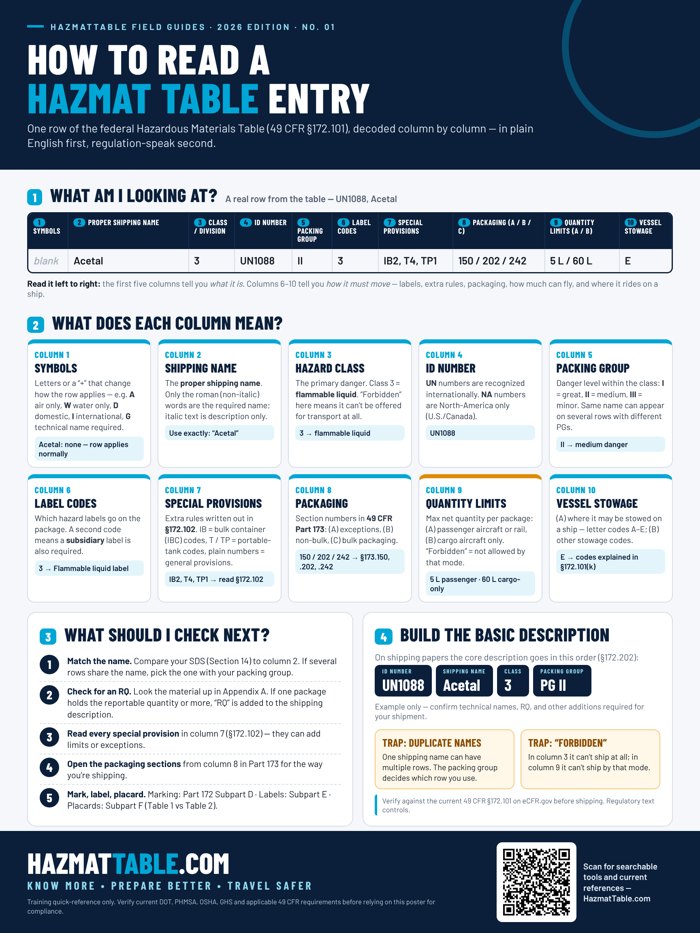
Get the HazmatTable Field Guide poster pack
8 printable hazmat reference posters — reading a table entry, hazard classes, placards, segregation, shipping papers and more. Free, sent to your inbox.